Basic points
A swift is an exclusively insectivorous bird. Absolutely.
Its digestive system is not designed to efficiently digest animal protein (cottage cheese, meat products), nor maggots, bloodworms, earthworms, gammarus, and the like. A swift's natural food is aerial plankton. Put simply, tiny flying insects. The closest equivalent in composition is feeder insects: crickets and cockroaches.
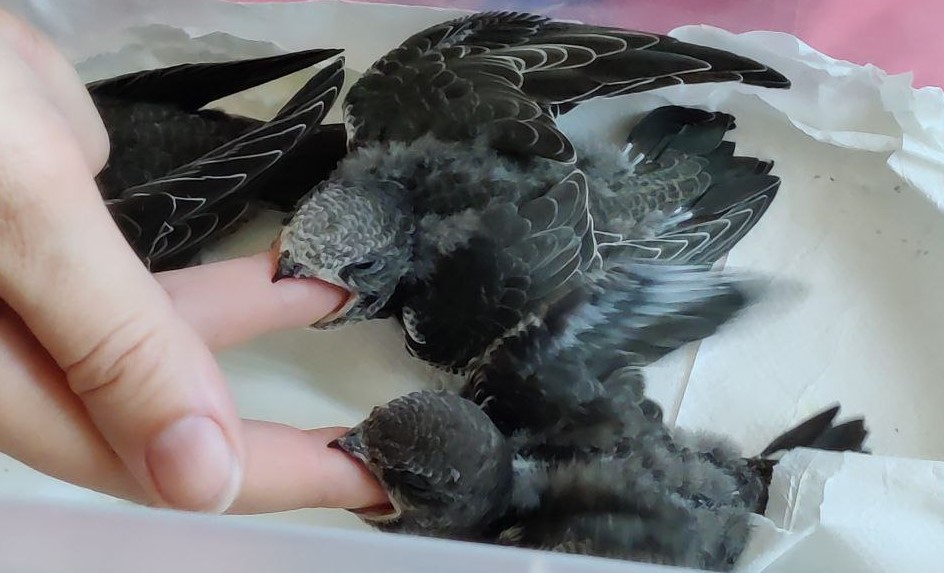
For a chick, the key goal is to grow feathers suitable for flight. Swifts literally live in the sky: they not only feed there, but also sleep in the air. They use a nest only during the breeding season. The set of feathers grown while in your care must allow the swift to reach southern Africa. If the chick survives but develops poor-quality plumage, it will not be able to return to the wild or will die soon after release. The advice here is conservative and aimed at producing good plumage and full physical development of the chick.
For the same reason, this guide excludes any bird food mixes, including those supposedly meant for insectivorous birds. See the methods of force-feeding swifts below the description of the main and supplementary food, or go straight to
Main food
- House or banana crickets
- Marbled or Turkestan cockroaches
These insects may be live (freshly killed) or frozen. It is better to buy them live and freeze them yourself. Insects come in different developmental stages. Imago are sexually mature (winged) insects; they are poorly suited for feeding because they are tough and require a lot of preparation. Pre-imago are large but not yet sexually mature and are ideal. Very small ones, not yet pre-imago, are also suitable, but they are somewhat expensive because you need a lot of them. All hard and sharp insect parts must be removed.
Supplementary food
- Zophobas (larvae)
- Mealworms
- Black soldier flies
Zophobas are too fatty to be the main food. But 3-5 zophobas per day can be added to the main feeder insects. Zophobas are fed without the head and without the intestines. Mealworms are poor in nutritional composition, so it is better not to make them the main food. In extreme cases, use them together with vitamin complexes. They also have a tough skin, so it is better to choose only freshly molted worms from the box (they are white). Black soldier flies are complete in composition and are very good food. Their only drawback is their low weight. A very large number of flies are needed for one feeding, so raising a swift on flies alone is labor-intensive.
If it is impossible to buy feeder insects
Natural food: - Frozen flies (not from sticky tape) - Grasshopper or locust abdomens - Plain-colored butterflies without wings (night moths first of all) - Plain-colored non-hairy caterpillars (not worms!) - Ant "eggs"
Important! Flies and grasshoppers caught in the wild must be frozen for at least 4 hours so as not to infect the bird with worms.
Short table of food amounts
| chick age (days) | Required food volume per day (g) | banana crickets per day (pcs.) | house crickets per day (pcs.) | small house crickets per day (pcs.) | large marbled cockroaches per day (pcs. of abdomens) | small whole marbled cockroaches (pcs.) |
|---|---|---|---|---|---|---|
| 10-16 | 20 | 60 | 100 | 200 | 80 | 160 |
| 17-20 | 18 | 54 | 90 | 180 | 72 | 144 |
| 21-38 | 15 | 45 | 75 | 150 | 60 | 120 |
And here is the detailed day-by-day table with the required amount of food and weight control for one swift chick
Read in detail about types of food in the dedicated section; there are many nuances
How to feed a swift
A chick that came to people when it was very small, and a fledgling that has already become used to being fed by a parent, will feed differently. In the case of a fledgling, feeding will most likely be forced. An adult swift is force-fed.
It has been observed that a group of several chicks usually feed better than singletons.
Food types in detail
Crickets
Pre-imago only (not winged):
- House cricket: 1.5-2 cm, high availability, protein 17.8%, fat 5.33%
- Banana cricket: up to 3 cm, protein 17.51%, fat 5.33%
- Two-spotted cricket: up to 3 cm, protein 17.7%, fat 5.33%
Preparation:
- Shake frozen crickets in a box to remove the legs
- Defrost in warm water (not boiling water)
- Place on a tissue, remove any remaining legs, crush the head (if hard); for large ones, it is better to pull out the head together with the intestines.
Cockroaches
Only cultivated feeder species are suitable; do not use household German cockroaches.
- Marbled cockroach: up to 3.5 cm, protein 22.13%
- Turkestan cockroach: ~2.5 cm, protein 18.16%, fat 8.645%
Preparation:
- Marbled cockroach: for large ones, use only the abdomens, cutting them lengthwise. Give small ones (1 cm) whole after removing the legs.
- Turkestan cockroach: remove the legs
Zophobas (larvae)
- Protein 17.4%, fat 16.56%
- Do not freeze!
Feeding frequency and portion calculation
- A chick eats 15-20 g per day; feed every 1.5-2 hours, approximately 8-9 times a day, with a 6-hour night break.
- An adult swift eats about 12 g per day, with 3-4 feedings (or even 2 feedings if it can eat the daily amount in two sittings)
Examples of portions per feeding:
- House crickets: 15-20 pieces (1.5-2 cm)
- Banana crickets: 10-15 large or 15-20 small
- Marbled cockroaches: 10-15 abdomens or 20-25 small ones
- Ant eggs: 1 heaped tsp.
Use scales accurate to 0.01 g to control portions.
What to do if there are no feeder insects
Quick options for obtaining food:
- Night moths: catch them using a basin of water with a light-colored cloth stretched behind it and a flashlight turned on.
- Grasshoppers/locusts: catch them in the grass; ask children to help. Freeze them, and give only the abdomens.
- A fly trap (not sticky tape); freeze the caught flies.
- Ant eggs: rinse them and form a "lump"
- Drone brood: obtain it from beekeepers
Vitamins
If there is not enough variety: - Multibiotin‑Birds (ExoticMenu) or NEKTON‑Biotin - Give daily until release. The powder is applied to the food with dry hands, or diluted in water and given by syringe like medicine behind the tongue, avoiding the respiratory openings
Feeding methods
Adult swifts and older chicks usually need to be fed by hand. Place the insect deep enough in the mouth for the bird to swallow it, then gently stroke the throat to trigger swallowing. Work calmly and carefully, and always make sure the breathing openings remain clear.
Waste as food for tits
Insect legs, heads, and shells can be stored in the freezer and added to winter food for tits.