Understanding what injuries and problems we may face and what to do about them
This page brings together many years of experience from swift rescuers in different cities and countries. All treatment plans and recommendations have been tested over the years. Do not change anything because you "think it would be better that way" without consulting a veterinarian or experienced experts!
Examining the swift
If you picked up an adult swift, gently rock the bird in your palm. Does the swift open and fold its wings symmetrically? Is there any blood on the feathers, body, wings, under the wings, or inside the beak? Are the eyes open and clear, with no signs of swelling on the eyelids?
Any fresh or dried blood should be a warning sign
Put a couple of drops of hydrogen peroxide on the area, then clean off the dirt with a cotton swab moistened with peroxide. If it fizzes, add more. Use peroxide only as a last resort, when you need to remove dirt or a blood clot from a wound.
If there is no blood or dirt, then use only chlorhexidine or miramistin for treatment.
If the feathers around the wound are too dried and stuck together, it is better to carefully trim them with small manicure scissors. After that, continue rinsing the wound a couple of times a day with room-temperature chlorhexidine or miramistin.
Do not use peroxide if bone is visible in the wound and you do not plan to remove it, otherwise you may cause periostitis (inflammation of the periosteum). Peroxide not only burns badly on an open wound, it also damages tissue and skin along the wound edge. The wound will never heal properly that way. Peroxide does not heal, it burns everything, both good and bad, and prolongs healing time.
Fifteen minutes after treating any open wound with Peroxide/Chlorhexidine, once it has dried, apply Levomekol or Levometil ointment (for purulent formations and as an antimicrobial), or sprinkle with Ranosan powder. The veterinary drug Monclavit also helps wounds heal well. You can prepare a wound powder yourself: mix one packet of streptocide with one crushed tablet each of metronidazole and furacilin. Even badly rotten wounds tighten up with this powder.
If you picked up a chick
Check for injuries and determine the degree of exhaustion.
If the chick is definitely exhausted and definitely has no injuries or TBI, you can start giving fluids to relieve dehydration and restart the GI tract.
Regidron is suitable for this and is sold in any regular pharmacy. Dilute according to the instructions and give 0.1 ml into the beak from an insulin syringe every half hour. 4-5 feedings are enough. You can also use Ringer-Locke solution or 5% glucose solution, or at worst Ringer solution, saline, or plain water.
ATTENTION! Use rehydration solutions only for emaciated chicks, when they have already gone hungry in the nest and everything inside has dried up.
For all other wounds and injuries, especially in adult birds, fluids should be given only as medications and a tiny amount of water, so that the total is no more than 10 drops per day.
All injured swifts must be given PAIN RELIEF: meloxicam or amelotex, or Movalis in ampoules (10 mg/1 ml), with dosing calculated for a 40 g bird. Actovegin can be added to the pain relief to support circulation.
-
For moderate injuries
Meloxicam or Amelotex tablets 7.5 mg.
Dissolve ½ tablet in 4 ml of boiled water, water for injection, or saline.
Meloxicam or Amelotex tablets 15 mg.
Dissolve ¼ tablet in 4 ml of boiled water, water for injection, or saline.
Store the solution in a syringe in the refrigerator for no more than 2 days. Shake and warm it in your hand before use.
Meloxicam or Amelotex or Movalis in ampoules.
0.1 ml + 0.9 ml water for injection, saline, or boiled water. Give the diluted medication into the beak at 0.01 ml for every 10 g of the swift’s weight, 2 times a day.
-
For severe cases
For the first two days, increase the dosage to 2 mg/kg. Starting from day 3, give pain relief according to the moderate injury plan.
Meloxicam or Amelotex tablets 7.5 mg.
Dissolve 1 tablet in 4 ml of boiled water, water for injection, or saline.
Meloxicam or Amelotex tablets 15 mg.
Dissolve ½ tablet in 4 ml of boiled water, water for injection, or saline.
Meloxicam or Amelotex or Movalis in ampoules.
0.1 ml + 0.45 ml water for injection, saline, or boiled water.
Give the diluted medication into the beak at 0.01 ml for every 10 g of the swift’s weight, 2 times a day.
-
For circulation
Actovegin injection solution 40 mg/ml.
It speeds up capillary blood flow, lowers capillary tone, improves cognitive function, and helps limb injuries heal better. Transfer the drug from the ampoule into a sterile syringe, expel all the air, and store it in the refrigerator for 7 days. Give 0.04 ml into the beak twice a day after warming it in your hand. Course length is 7-14 days, then according to condition.
Labeling syringes with medications
When treating a bird, the refrigerator quickly fills up with syringes containing different medications. Not only can many of them look visually similar, but their storage times also differ.
To avoid keeping terabytes of information in your head, getting medications mixed up, or forgetting expiration times and risking giving a swift expired medicine, it is better to label the syringes in a simple way: wrap a strip of paper with the name of the medicine and the dilution date written on it around the syringe and secure it with a stapler.
You can also use masking tape for this by sticking it lengthwise along the syringe, or use paper-based adhesive bandage tape.

Labeling syringes with medications
Giving medication to a swift
You will need an insulin syringe to measure the correct amount of medicine. These are often much cheaper from large online marketplaces than in a pharmacy.
Syringes come in different types
Use the picture as a guide depending on which syringe you bought. To give liquid medications into the beak, you need syringes with a removable needle.
The most convenient syringe for swifts is the U-100. Each mark on this syringe equals 0.01 ml. Accordingly, 2 marks = 0.02 ml, 4 marks = 0.04 ml, and so on. The number 10 on the syringe scale corresponds to 0.1 ml, 20 = 0.2 ml, etc.
For injections, it is better to use the BD Micro-Fine Plus DEMI 0.3 ml syringe. It has a short and very thin non-removable needle that does not tear muscle tissue but parts it. After the injection, the needle can be pulled out with pliers and the syringe can be used for giving water or Thiamine.

Types of insulin syringes
How to give medication to a swift
In the video, avian veterinarian Maria Markina shows in detail how to give a swift any liquid medication, and thiamine in particular, because we need to be sure that the swift actually swallowed the medicine and did not just flick it off the tip of its beak.
Using this method, you definitely will not break the beak, pull out feathers, flood the breathing openings in the mouth, or have the swift spit anything out. The bird will swallow the full dose.
How to give liquid medicine to a swift
Traumatic brain injury (TBI) in a swift
First, let’s determine for sure whether our rescued bird has a TBI.
Carefully review the list of TBI signs.
A bird with a concussion must be kept in the dark and disturbed as little as possible.
Signs of TBI in a swift
Not all signs of TBI have to be present. Every organism is individual. One bird may have 5 signs, another only one; in some they may be stronger, in others weaker. So if the bird, chick or adult, shows even one sign of TBI, treatment must begin immediately.
Pay attention to the droppings. If something brown appears in them, it may be clotted blood. Drop some peroxide on it. If it fizzes, then it is blood and there is internal bleeding.
In this case, give 0.03 ml of Vitamin C from an ampoule into the beak as a one-time dose. It reduces vascular permeability, helping stop the bleeding and the leakage of large amounts of plasma from the bloodstream.
- Injuries, hematomas, or blood on the head or in the mouth.
- In a dark room, for example in the bathroom, shine a flashlight into the bird’s eyes one at a time and compare how quickly the pupils constrict. If the speed is noticeably different, the bird has TBI.
- One possible sign is an unnatural squint, especially if only one eye is squinting.
- Lethargy, drowsiness, poor coordination. Lethargy and drowsiness can also occur with exhaustion, so pay attention specifically to the coordination problem.
- Pupils of different sizes and unfocused eyes.
- The bird leans to one side, tucks the leg on the side it is leaning toward, grips poorly with that foot or does not grip at all, clenches it into a fist, and lets the wing droop as if it cannot keep it against the body, even though there are no visible injuries to either the leg or wing.
- The bird unnaturally throws back or twists its head.
- Swelling of the eyes, puffy eyes.
- It "watches trains" with a large or small amplitude, moving its head from side to side as if counting the cars of a passing train.
- There may be vomiting.
This is what a swift with severe TBI looks like. It cannot even move normally, it keeps toppling over and flipping. Its head is lowered with its beak to the floor. Movements are chaotic and unsteady.
Treat this according to the severe TBI protocol (see below). Do not delay!
Swift with severe TBI
Bird stabilization protocol for TBI
Emergency actions are aimed primarily at stabilizing the bird in the first few hours and days. B12 is involved in restoring the nervous system and in blood formation, and it has an overall anti-inflammatory effect. Calcium acts against shock and inflammation and also corrects hypocalcemia, which always develops in birds with severe trauma.
For TBI of any severity, it is essential to place bolsters around the bird so it can rest its head on them instead of sitting with its beak on the floor. The head should be positioned at a 35-45 degree angle so fluid does not rush to the brain but instead drains away.
-
1. Oxygen
Oxygen therapy is especially important in the first hours after a bird with TBI is found. Birds have a special anatomy and find it very difficult to breathe without movement, especially while lying down, and in critical conditions respiratory function decreases sharply. During the first day, and especially in the first hours, oxygen is absolutely vital.
It is sold in almost all pharmacies. An oxygen canister + a container or shoe box = an oxygen chamber.
5-10 minutes after being placed in the oxygen chamber, give calcium and B12.
-
2. Vitamin B12 and Calcium
The dose for all these medications is 0.01 ml for every 10 g of body weight, 2 times a day for the first 3 days, then once a day from day 4 until release. The swift should be weighed. If it weighs 42 g, for example, then give 0.04 ml of calcium and 0.04 ml of B12. These drugs are not antagonists, so they are given almost at the same time, one after the other, into the beak. If Vitamin C was given, then B12 can only be started after 24 hours, so give only calcium at first and add B12 the next day.
Watch the video on how to do this correctly so the swift does not aspirate.
Calcium gluconate can be stored in the refrigerator for 3 days. Pour the remainder from the ampoule into a regular sterile syringe, expel all the air, and wrap the syringe in foil.
B12 does not keep. Any leftover from the ampoule can be poured into your plants, rubbed into your hair, or injected into yourself.
Draw borgluconate by puncturing through the rubber stopper; store until sediment appears or until the expiry date. -
3. Pain relief
Baralgin in ampoules. Baralgin must always be diluted. Dilute 0.5 ml from the ampoule in 10 ml of water for injection or saline and give into the beak at 0.01 ml for every 10 g of bird weight once a day for 3 days, then according to condition. It can be given right after B12 and calcium.
The diluted medication, as well as any pure leftover medication from the ampoule, should be stored in a sterile syringe wrapped in foil with all air expelled, in the refrigerator for 3 days.
Severe TBI
With severe TBI, many reflexes disappear, including the swallowing reflex, so there is no point feeding during the first day. In this condition the bird has no strength to digest food, and the risk of aspiration is very high, especially if the swallowing reflex is reduced or absent. With severe TBI the risk of death is very high, so food is not the priority.
The exception is severe emaciation. In that case, feed only after the initial emergency measures and only with squeezings, which do not need to be swallowed because they will slide down on their own.
Immediately place the bird in an oxygen chamber.
After 5 minutes, give an intramuscular injection of Furosemide. If you cannot inject, Furosemide also works well through the mucous membranes, so you can give it into the beak at the side of the tongue.
Furosemide is given as a single dose. It relieves overall internal swelling. Within 10-20 minutes the bird should start reacting to its surroundings and should produce droppings.
Ampoule form 10 mg/ml (injection or into the beak) --- 0.02 ml for a 40 g swift.
Tablets 40 mg (into the beak only) --- dissolve 1 tablet in 10 ml of water, give 0.06 ml into the mouth.
The solution works faster than the tablet.
If the swift is emaciated, give a subcutaneous injection of 0.5 ml saline.
After 3-5 hours, begin the main treatment described above.
What NOT to do with TBI!
- Do not give the swift a lot of water!
Too much water can cause brain edema and lead to death. Therefore water must be given very sparingly, literally 10 drops a day. Let those drops be the medications rather than plain water.
- Do not warm the head!
Heat destroys tissue, causes pus to form, and spreads infection.
Seizures
When the swift twists up specifically as a consequence of TBI, smear a little Sulfocamphocaine near the nostrils and give 1-2 drops into the beak.
Oxygen chamber
It is quite easy to make an oxygen chamber at home. You need an airtight container or shoebox, an oxygen canister from the pharmacy, and a tube.
Make a hole in the side of the container or box for the tube. In the lid of the container, make a couple of holes with an awl to vent carbon dioxide. No holes are needed in a cardboard box.
Line the bottom with paper towels, napkins, toilet paper, basically whatever the swift will lie on. Put the swift into the container and snap the lid shut. Insert the tube. Spray 1 puff per minute until the canister is empty.
Another oxygen chamber option: a shoe box and an oxygen canister with a mask. Indira shows in detail in the video how she does it.
Oxygen chamber for TBI. watch this video on YouTube
Store all diluted medications in the refrigerator. The number of storage days is given in the descriptions of the dilution protocols. Before drawing from a syringe to give the swift the medicine, shake the syringe with the solution so it becomes uniform. Warm the insulin syringe with the drawn medication in your hand so the medicine becomes warm.
Vitamin B1 (Thiamine)
What are the dangers of thiamine deficiency or excess for a swift? Why does a swift need Vitamin B1? And how should it be used? This section contains a brief summary from medical encyclopedia descriptions of thiamine properties, studies on the effects of thiamine deficiency and excess in farm birds, and the practical experience of swift rescuers.
Symptoms of B1 deficiency in swifts
--- loss of appetite
--- weight loss
--- fluffed-up plumage
--- falling over to one side, unsteady gait
--- lethargy, apathy
--- the swift sits with its beak on the floor
--- the swift cannot swallow food and chokes
--- trembling, head tremor, head bobbing
--- seizures
The first signs of thiamine deficiency in a swift
With vitamin B1 deficiency, a swift may begin having seizures
Birds are especially sensitive to deficiencies of B vitamins.
Vitamin B1 (thiamine) is a water-soluble vitamin. It is a biologically active compound necessary for normal metabolism, energy production, and proper functioning of the neuromuscular system.
Thiamine is not synthesized by the body. It enters the body with food. In home rearing conditions using frozen insects, in which thiamine is destroyed, thiamine deficiency develops. When feeding live insects, thiamine is given only occasionally, only when the bird shows lethargy or anxiety.
What seizures in a swift due to vitamin B1 deficiency look like
-
B1 deficiency is characterized primarily by damage to the nervous system, atrophy of skeletal and cardiac muscle, and pronounced pathological anatomical changes
If the food contains too little thiamine, deficiency develops, which can appear in two clinical forms: hypovitaminosis and avitaminosis. Hypovitaminosis is a moderate deficiency, while avitaminosis is a deep vitamin B1 deficiency. Hypovitaminosis of vitamin B1 causes metabolic disturbances. The biological role of vitamin B1 is its participation in carbohydrate metabolism. Thiamine is part of the enzyme carboxylase, which regulates the breakdown of keto acids. When thiamine is lacking, the breakdown of pyruvic and lactic acids is delayed, and they accumulate in tissues, mainly in brain cells. Excess of these acids reduces the ability of brain cells to take in oxygen and carry out normal oxidative processes. As a result, nervous system function is disrupted and polyneuritis develops (multiple nerve lesions).
Thiamine avitaminosis causes seizures and can lead to the bird’s death.
-
Thiamine is found in all tissues and organs of birds
The highest amounts are found in the liver, kidneys, heart, and brain; moderate amounts in muscles; and small amounts in the lungs. Once it enters the body, it is used immediately and directly where needed. Excess thiamine in a bird is easily excreted in the urine portion of the droppings. Since this micronutrient is a water-soluble compound, it is not stored in the body, does not accumulate in tissues and organs, and has no toxic properties. Even with long-term use of high doses of vitamin B1, no side effects on the nervous system develop. Excessive thiamine supplementation is not a problem, because the toxic dose is 700 times higher than the standard level.
The presence of mycotoxins and parasites can also contribute to thiamine deficiency. Endoparasites such as coccidia and helminths (worms) compete with the host for thiamine, so parasite infestation may be decisive in nutrient deficiency.
Since vitamin B1 cannot accumulate in tissues and form any meaningful reserve, normal body function requires regular intake with food. Therefore swifts must be given vitamin B1 calculated as follows: 0.01 ml for every 10 grams of body weight into the beak every one or two days. The dose is given at once, or it can be divided into two parts: morning and evening.
B1 mixed with Taufon (taurine eye drops) in a 1:1 ratio is absorbed better when given orally. In addition, taurine is a substance that improves metabolism.
But what if the moment was missed and the swift started having seizures? What should you do?
You must react immediately! Urgently give 0.1 ml of pure undiluted vitamin B1 into the beak and put the bird in a dark place. On the first day, give another 3-4 doses of 0.05-0.1 ml. On the following days, give it 2-3 times a day depending on the bird’s condition.
During severe seizures, it is important to warm the swift in your hands and straighten its neck so it does not suffocate. The warmth of your hands helps relax the muscles and reduces pain. Thiamine in the beak does not work immediately, so with severe seizures it is better to give a 0.04 ml intramuscular injection of Thiamine.
Attention! Intact breast muscles are very important for flighted swifts, so injections should be given only in the most critical situation.
Intramuscular injection for a swift
For intramuscular injection, it is better to use the BD Micro-Fine Plus DEMI 0.3 ml insulin syringe. It has a short and very thin needle that does not tear muscle tissue but rather parts the fibers. If you do not have one at home, you can use a regular insulin syringe.
In the video, Elena Traitak explains in detail how to give an Eleovit injection. Any medicine the swift needs at the moment is injected the same way. The main thing is to calculate the dosage correctly by weight.
At the beginning of the video there is the Samara scheme on a napkin showing where to inject. Feel for the keel with your fingers, mentally divide the keel in half vertically, step 1 cm away from the keel, and inject deep into the muscle in the upper half.
Intramuscular injection for a swift
Important! An opened ampoule cannot be stored! Once opened, thiamine breaks down within 10 minutes. So each time open a new ampoule. Give one drop to the swift and use the rest on yourself, either intramuscularly or by mouth.
Store unopened packs of thiamine ampoules in the refrigerator.
Which manufacturer’s thiamine should you buy?
Not all thiamine preparations are equally effective, so let’s look at which one we need.
- Thiamine made in Yerevan
- Moskhimfarmpreparaty named after N.A. Semashko
- Borisov Pharmaceutical Plant
- The Far Eastern one often turns out to be useless, so it is not recommended for swifts.
ATTENTION! Swifts should be given only thiamine! Do not give swifts Milgamma!
During treatment with antibiotics and sulfonamide drugs, the thiamine dose is doubled and given 6 hours after the medications.
For cat bites
Death from pasteurella infection can occur within a few hours, so it is essential to start giving the swift an antibiotic as soon as possible. Even if the cat only held the bird in its mouth and there are no visible wounds, an antibiotic is still urgently needed. Sometimes there are microscopic wounds that cannot be seen. But even if there are none at all (for example, a toothless cat), pasteurella is dangerous even if it enters the GI tract. If it enters the bloodstream, it is deadly; if it enters the GI tract, it is moderately dangerous.
-
For an adult swift
Ciprofloxacin at a dosage of 30-40 mg/kg twice a day. There are many brand names, so look at the active ingredient (Ciprofloxacin).
Dissolve ¼ of a 250 mg tablet in 5 ml of boiled water, water for injection, or saline and give 0.1-0.12 ml into the beak 2 times a day. The solution keeps in the refrigerator for 3 days.
Treatment course: 21 days.
-
For a chick
Amoxiclav (Amoxicillin/clavulanate). Dissolve ½ of a 500 mg Amoxiclav tablet in 5 ml of water for injection or saline and give 0.1 ml 2 times a day. The solution keeps in the refrigerator for 5 days, after which a fresh batch must be made. The standard dosage given is for a 40 g swift. If the bird weighs less, divide 0.1 by 40 to get 0.0025 ml per 1 gram of body weight. Multiply by the swift’s weight to get the required amount. Example: 32 g x 0.0025 = 0.08 ml.
Treatment course: 21 days.
All calculations are for the prevention/treatment of pasteurellosis. For other infections, dosages may vary within other ranges.
-
Starting from day 2-3 of antibiotic treatment, add antifungal medications
Fluconazole/Diflucan 50 mg is a broad-spectrum systemic antimycotic against yeast fungi. Dissolve 1 capsule in 5 ml of water. Give 0.04 ml into the beak (calculated for 40 g body weight) 2 times a day. Store the solution in the refrigerator for no more than 24 hours.
You can dilute ¼ of a capsule in 1.25 ml of water, which will make enough for two doses plus a little extra you will not mind throwing away. ORNystatin is a broad-spectrum antifungal medication.
Dosage:- 100,000 units/kg: dissolve 1 tablet in 1.2 ml
- 150,000 units/kg: dissolve 1 tablet in 1.3 ml
- 500,000 units/kg: dissolve 1 tablet in 4 ml
Calculations are for a 40 g bird. Give 0.1 ml into the beak 2 times a day between meals. Continue antifungal medications for 4 more days after antibiotics are finished.
Important! After the antibiotic course is completed, a probiotic should be given to restore beneficial bacteria in the body. This can be Linex. Dip the insect in the powder and give ½ capsule per day.
-
A hepatoprotector is also given during antibiotic treatment to support the liver
Hepatovet suspension is sold in veterinary pharmacies and also on Ozon and Wildberries. Dosage: 0.05 ml 2 times a day. Hepatovet is more effective than Carsil. Carsil is more of a supplement, while Hepatovet is recommended by avian veterinarians. Heptral (from a regular pharmacy) has also proven very effective. The injectable form (in ampoules) is a two-component preparation consisting of dry substance and solvent. Mix both components and immediately divide into insulin syringes in 0.1 ml portions: 1 syringe = 1 dose, and freeze them.
Heptral tablets 400 mg. Crush one tablet and dissolve it in 5 ml of water, then also freeze in insulin syringes in portioned doses.
Before each use, thaw the dose naturally, warm it in your hand, shake it, and give it warm 2 times a day. DO NOT REFREEZE! The dosage is calculated for a 40 g bird.ATTENTION! During antibiotic treatment, thiamine is absorbed very poorly. Double the thiamine dose or give it daily to avoid deficiency.
ATTENTION! When giving liquid medications, keep a one-minute interval between drugs so the bird does not aspirate. Aspiration may go unnoticed, but it can cause pneumonia. Insert the insulin syringe with the medication deeper than the breathing openings, as shown in the video at the beginning of this page.
GI problems
Any disruption of the GI tract can lead to death. A swift is a very small bird, so you need to act quickly.
Poisoning in a swift
Poisoning can happen because of poor-quality food. If measures are not taken in time, the swift will die from intoxication.
The droppings smell bad (normally they are odorless), the swift often wants to drink, puffs up, becomes weak, and lies with its beak on the floor.
Be sure to give the swift more water to drink! Warm it in your hands or under your clothes against your body, this is important in poisoning.
Enterosgel (or Enterodes): dilute a pea-sized amount about the size of a match head in 3 drops of water and give it deep into the throat 2 hours before feeding. Do this 3 times a day.
You can squeeze that pea into a syringe, then draw up 0.08 ml of water, shake it, and give it. You can also place it directly in the mouth with a finger and then let the bird drink water.
Be sure to read the storage instructions. Keep it tightly wrapped in a bag, because this drug absorbs everything even from the air.
Activated charcoal (very weak and much less effective than Enterosgel): hide small pieces of the tablet in food. Over 4 hours, feed half a tablet.
Indigestion in a swift
For indigestion, Motilium or its analogues are given. It makes the esophagus contract, helping the swift chick swallow food.
Shake Motilium and give 1 drop. After 15 minutes give 1-2 squeezings with Mezim and a couple of drops of saline. An hour later give 1 drop of liquid paraffin. Another hour later give Motilium again. After 15 minutes give 1-2 squeezings with Mezim and again a couple of drops of saline. After another hour to hour and a half, give Enterosgel and leave the bird alone for 4 hours on a heating pad.
All squeezings and medications must be given warm!
The swift swallowed a thread
This is why the home page at the very beginning of the site, when you have just found a swift, emphasizes that bedding in the swift’s temporary housing should be arranged without using fabric, especially fabrics from which a thread can easily be pulled and wound around a leg.
What should you do? A regular pharmacy sells liquid paraffin (see below). Exactly the oil! Give two warm drops from a syringe every 2 hours behind the tongue deep into the throat, as shown in the video at the very beginning of the page.
Oil does not "soak in" anywhere in animals, but it helps remove foreign bodies. Do not pull the thread! After the thread comes out, give Enterosgel.
Constipation in a swift
A swift should have droppings after every feeding. If there is constipation, you need to act quickly. Constipation may appear either as a complete absence of droppings or as completely white droppings without the black component. The white part is urine, and the black part is what was not digested. So droppings must be monitored very closely.
The first signs of constipation in a swift are not always easy to recognize. It may seem that nothing is happening, the swift is not anxious, but it is not lethargic either. If in the morning the swift has no capsule, or it is very small, or there is only the white part and no black component, that is a reason to check the cloaca. If it is sticking out even a little, these are already signs of constipation. Measures must be taken immediately.
Watch the video carefully. The swift is sitting in one place with its wings spread, leaning its rear backward as if it cannot move forward, backing up, and squeaking at the same time. It is straining but unable to pass anything. This behavior should alert you.
The first signs of constipation in a swift
Immediately feel the abdomen and check the swift’s cloaca. In a normal state it does not protrude anywhere, is almost invisible under the feathers, and cannot always even be found by touch. At the very beginning of constipation, swelling appears.
Your actions depend on the scale of the disaster you find, but they must be immediate.
If you discover constipation at an early stage, then:
1. Give 1-2 drops of lactulose syrup from an insulin syringe (this may be Duphalac or any other lactulose-based laxative sold in pharmacies), and after an hour give 1 more drop. Between doses of Duphalac, give several drops of warm water, massage the belly clockwise including the cloaca, and place the swift on something warm: a warm electric mat, a heating pad, or even a hot tea bag, which holds heat well. If things start moving well, then the second dose of lactulose syrup can be given not after one hour but after two.
Also continue massaging the abdomen and cloaca and keep the bird warm so the rear can relax.

photo 1: cloaca in a normal state; photo 2: slight bloating indicates constipation
2. If the first step did not help or the situation is already advanced, give an enema. Feel the abdomen to determine by touch the scale of the problem and where the blockage is. The amount of enema solution depends on where the blockage is. If it is far from the cloaca, use 0.1-0.15 ml; if it is close, 0.05 ml.
Mix liquid paraffin with warm water. NOT HOT! Draw the amount appropriate to the location of the blockage into an insulin syringe WITHOUT A NEEDLE. Lubricate the tip of the syringe with oil so it can enter the cloaca. Wrap the bird in a napkin, leaving the tail and rear exposed. Turn the bird onto its back and gently insert the tip of the syringe into the cloaca. Do not inject it all at once, but little by little, in small pushes. Keep holding the bird belly-up and gently massage the abdomen in the area of the blockage, pushing the stone out by pressing from the sides. Do everything very carefully because the area is filled with solution.
Turn the bird back into its natural position and it will have a reflex to empty itself. The droppings soften in warm water or oil and come out like sand.

photo 1: bottle of liquid paraffin for oral use; photo 2: first portion of passed droppings; photo 3: second portion; photo 4: completely passed plug
The syringe tip is quite thick, about 5 mm, and it is difficult to get it into a swift’s cloaca. So for an enema it is better to use a urinary catheter or a butterfly needle set. You can buy them at a pharmacy, on Ozon, or on Wildberries.
Catheters come in different sizes, marked by a letter abbreviation with numbers, for example Ch/Fr 14. You need Ch/Fr 6, whose thickness is only 2 mm.
You can also use a butterfly needle set for blood collection. The needle itself should be cut off and only the "tube" used. The thickness of this "tube" is about 2.5 mm.
Both devices have a special cap that fits onto the tip of the syringe.

photo 1: butterfly needle; photo 2: butterfly needle attached to a syringe; photo 3: urinary catheter
If urine (the white part of the droppings) is visible at the exit, you need to reduce its volume by breaking it apart with a--- layout: default title: Medicines icon: material/medical-bag description: About the use of medications. lang: en is_home: false
What injuries and problems can we face, and what should we do about them
This page brings together many years of experience from swift rescuers in different cities and countries. All treatment protocols and recommendations have been refined over the years. Do not change anything because you “think it might be better” without consulting a doctor or experienced experts.
Examining the swift
If you picked up an adult swift, gently rock the bird in your palm. Does the swift open and fold its wings symmetrically? Is there any blood on the feathers, body, wings, under the wings, or inside the beak? Are the eyes open and clear, with no sign of swelling on the eyelids?
Any fresh or dried blood should be a warning sign
Put a couple of drops of hydrogen peroxide on the spot, then clean away dirt with a cotton swab moistened with peroxide. If it fizzes, keep applying more. Use peroxide only as a last resort, when you need to remove dirt or a blood clot from a wound.
If there is no blood or dirt, then use only chlorhexidine or Miramistin for treatment.
If the feathers around the wound are too dried out, it is better to carefully trim them with manicure scissors. After that, continue rinsing the wound a couple of times a day with room-temperature chlorhexidine or Miramistin.
Do not use peroxide if bone is visible in the wound and you do not plan to remove it, otherwise you may cause periostitis (inflammation of the periosteum). Peroxide not only stings badly on an open wound, it also burns the tissue and skin along the wound edges. That prevents the wound from ever closing properly. Peroxide does not heal, it burns everything, both good and bad, which only prolongs healing time.
All open wounds should be treated 15 minutes after Peroxide/Chlorhexidine, once the area has dried, with Levomekol or Levometil ointment (for purulent lesions and antimicrobial action); you can also dust with Ranosan powder. The veterinary product Monclavit also heals wounds well. You can prepare a powder yourself: mix one sachet of streptocide with one crushed metronidazole tablet and one crushed furacilin tablet. Even badly rotten wounds can close with this powder.
If you picked up a chick
Examine it for injuries and determine the degree of exhaustion.
If the chick is definitely exhausted and clearly has no injuries or TBI, you can start giving fluids to relieve dehydration and restart the digestive tract.
Regidron, sold in any regular pharmacy, will work for this. Dilute according to the instructions and give 0.1 ml into the beak from an insulin syringe every half hour; 4-5 doses are enough. You can also use Ringer-Locke solution or 5% glucose solution, or if necessary plain Ringer’s solution, saline, or ordinary water.
ATTENTION! Give fluids only to emaciated chicks when they have already gone hungry in the nest and everything inside has dried out.
For all other wounds and injuries, especially in adult birds, fluids should be limited to medications plus a tiny bit of water, with a total of no more than 10 drops a day.
All injured swifts must be given PAIN RELIEF: meloxicam, Amelotex, or Movalis in ampoules (10 mg/1 ml), with calculations based on a 40 g body weight. Actovegin can be added to the pain relief to support circulation.
-
For moderate injuries
Meloxicam or Amelotex tablets 7.5 mg.
Dissolve ½ tablet in 4 ml of boiled water, water for injection, or saline.
Meloxicam or Amelotex tablets 15 mg.
Dissolve ¼ tablet in 4 ml of boiled water, water for injection, or saline.
Store the solution in a syringe in the refrigerator for no more than 2 days. Shake before use and warm in your hand.
Meloxicam or Amelotex or Movalis in ampoules.
0.1 ml + 0.9 ml water for injection, saline, or boiled water. Give the diluted medicine into the beak at 0.01 ml for every 10 g of swift body weight, 2 times a day.
-
For severe cases
For the first two days, increase the dosage to 2 mg/kg. Starting on day three, switch to the pain-relief regimen for moderate injuries.
Meloxicam or Amelotex tablets 7.5 mg.
Dissolve 1 tablet in 4 ml of boiled water, water for injection, or saline.
Meloxicam or Amelotex tablets 15 mg.
Dissolve ½ tablet in 4 ml of boiled water, water for injection, or saline.
Meloxicam or Amelotex or Movalis in ampoules.
0.1 ml + 0.45 ml water for injection, saline, or boiled water.
Give the diluted medicine into the beak at 0.01 ml for every 10 g of swift body weight, 2 times a day.
-
For circulation
Actovegin injection solution 40 mg/ml.
It speeds up capillary blood flow, reduces capillary tone, improves cognitive function, and helps healing in limb injuries. Transfer the medicine from the ampoule into a sterile syringe, expel all air, and store it in the refrigerator for 7 days. Give 0.04 ml into the beak twice a day after warming it in your hand. Duration: 7-14 days, then according to condition.
Labeling syringes with medicines
When treating a bird, a lot of syringes with different medications start accumulating in the refrigerator. Not only can the medicines look visually similar, but their storage times are different too.
To avoid keeping terabytes of information in your head, mixing up medicines, or forgetting expiration times and accidentally giving the swift expired medication, it is better to label the syringes in a simple way: wrap a strip of paper around the syringe with the medicine name and dilution date written on it, then secure it with a stapler.
You can also use painter’s tape by sticking it lengthwise on the syringe, or a paper-based adhesive bandage.
Labeling syringes with medicines
photo is clickable
Giving medicine to a swift
You will need an insulin syringe to measure the correct amount of medicine. Syringes can be bought on Ozon, Wildberries, or Magnit Market, where they are much cheaper than in pharmacies.
Syringes come in different types
Use the picture as a guide depending on which syringe you bought. To give liquid medicines into the beak, you need syringes with a removable needle.
The most convenient syringe for swifts is the U-100. Each mark on this syringe equals 0.01 ml. So 2 marks = 0.02 ml, 4 marks = 0.04 ml, and so on. The number 10 on the syringe scale corresponds to 0.1 ml, 20 = 0.2 ml, etc.
For injections, it is better to use the BD Micro-Fine Plus DEMI 0.3 ml syringe. It has a short, very thin fixed needle that does not tear the muscles, but parts them. After the injection, the needle can be removed with pliers and the syringe used to give water or thiamine.
Types of insulin syringes
photo is clickable
How to give medicine to a swift
In the video, avian veterinarian Maria Markina shows in detail how to give any liquid medicine to a swift, and thiamine in particular, because we need to be sure the swift actually swallowed the medicine and did not just shake it off the tip of its beak.
With this method you definitely will not break the beak, pull out feathers, flood the breathing slits in the mouth, or have the swift spit anything out. The bird will swallow the full dose.
How to give liquid medicine to a swift
Traumatic brain injury (TBI) in a swift
First, let’s determine for sure whether our rescued bird has TBI.
Carefully study the list of TBI signs.
A bird with concussion must be kept in the dark and disturbed as little as possible.
Signs of TBI in a swift
Not all signs of TBI have to be present. Every organism is different. One bird may show 5 signs, another only one; in some the signs are stronger, in others weaker. So if a bird, chick or adult, shows even one sign of TBI, treatment should begin immediately.
Pay attention to the droppings. If something brown appears in the droppings, it may be clotted blood. Put a drop of peroxide on it. If it fizzes, then it is blood and there is internal bleeding.
In this case, give 0.03 ml of vitamin C from an ampoule into the beak once. It reduces vascular permeability, which helps stop the bleeding and prevents excessive plasma from leaving the bloodstream.
- Injuries, bruising, or blood on the head and in the mouth.
- In a dark room, for example a bathroom, shine a flashlight into the bird’s eyes one at a time and compare how quickly the pupils contract. If the speed is noticeably different, the bird has TBI.
- One possible sign is an unnatural squint, especially if only one eye is squinting.
- Lethargy, sleepiness, and poor coordination. Lethargy and sleepiness can also occur with exhaustion, so focus specifically on the lack of coordination.
- Pupils of different sizes and unfocused pupils.
- The bird falls to one side, tucks the leg on the same side under itself, grips poorly with that foot or not at all, clenches it into a fist, lets the wing hang as if it cannot hold it close to the body, although there is no visible injury to either the leg or the wing.
- The bird unnaturally throws back or twists its head.
- Swelling of the eyes, puffy eyes.
- It “watches trains” in a large or small amplitude, moving its head from side to side as if counting the train cars going by.
- There may be vomiting.
This is what a swift with severe TBI looks like. It can’t even move properly, it keeps falling over and turning upside down. Its head is lowered, with the beak to the floor. The movements are chaotic and unsteady.
This must be treated according to the severe TBI protocol (see below). Do not delay!
Swift with severe TBI
Bird stabilization protocol for TBI
Resuscitation efforts are aimed first and foremost at stabilizing the bird during the first few hours and days. B12 helps restore the nervous system and also participates in blood formation; it also has a general anti-inflammatory effect. Calcium acts as an anti-shock and anti-inflammatory agent and also corrects hypocalcemia in birds, which always develops after severe trauma.
With TBI of any severity, the bird must be supported with rolled pads it can rest its head on, so it does not sit with its beak on the floor. The head should be at an angle of 35-45 degrees so fluid does not rush to the brain but instead drains away.
-
1. Oxygen
Oxygen therapy is especially important in the first hours after finding a bird with TBI. Birds have special anatomy and it is very hard for them to breathe without movement, especially while lying down; in critical conditions respiratory function also drops sharply. So during the first day, and especially the first hours, oxygen is vital.
Oxygen can be bought in almost any pharmacy. An oxygen canister + a container or shoe box = an oxygen chamber.
After 5-10 minutes in the oxygen chamber, give calcium and B12.
-
2. Vitamin B12 and calcium
The dosage of all these medications is 0.01 ml for every 10 g of body weight, 2 times a day for the first 3 days; from day 4 until release, once a day. The swift must be weighed, and if it weighs 42 g, for example, then 0.04 ml of calcium and 0.04 ml of B12 are given. These medications are not antagonists, so they are given almost at the same time, one after another, into the beak. If vitamin C was given, then B12 can only be started after 24 hours, so give only calcium first and add B12 a day later.
Watch the video to see how to do this correctly without making the swift aspirate.
Calcium gluconate can be stored in the refrigerator for 3 days. Pour the remaining solution from the ampoule into a sterile syringe, expel all the air, and wrap the syringe in foil.
B12 cannot be stored. The remainder from the ampoule can be poured into flower pots, rubbed into your hair, or injected into yourself.
Borgluconate should be drawn through the rubber stopper and stored until sediment appears or until the expiration date. -
3. Pain relief
Baralgin in ampoules. Baralgin must always be diluted. Dilute 0.5 ml from the ampoule in 10 ml of water for injection or saline and give 0.01 ml into the beak for every 10 g of bird weight once a day for 3 days, then according to condition. It can be given right after B12 and calcium.
The diluted medication, as well as the remaining undiluted medication from the ampoule, should be stored in a sterile syringe wrapped in foil with all air expelled, in the refrigerator for 3 days.
Severe TBI
In severe TBI many reflexes disappear, including the swallowing reflex, so there is no point feeding during the first day. In this state the bird has no strength to digest food, and the risk of aspiration is very high, especially if the swallowing reflex is reduced or absent. With severe TBI the risk of death is very high, so food is not the first priority.
The exception is severe exhaustion. In that case, feed only after the initial resuscitation steps, and only with squeezings, since they do not need to be swallowed and will slide down on their own.
Immediately place the bird in an oxygen chamber.
After 5 minutes, give an intramuscular injection of furosemide. If you cannot inject, furosemide also works well through the mucous membranes, so it can be given into the beak at the side of the tongue.
Furosemide is given once. It relieves general internal swelling. Within 10-20 minutes, the bird should begin reacting to what is happening around it and should produce droppings.
Ampoule 10 mg/ml (injection or into the beak) --- 0.02 ml for a 40 g swift.
Tablets 40 mg (into the beak only) --- dissolve 1 tablet in 10 ml water, give 0.06 ml by mouth.
The solution works faster than the tablet.
If the swift is exhausted, give a subcutaneous injection of 0.5 ml saline.
After 3-5 hours, begin the main treatment described above.
What is important NOT to do with TBI!
- Do not give the swift a lot of water!
Too much water can cause brain swelling, which will lead to death. So water must be given very sparingly, literally 10 drops a day. Let those drops be medications instead of plain water.
- Do not warm the head!
Heat destroys tissue, causes pus to form, and spreads infection.
Convulsions
When the swift twists up specifically as a result of TBI, smear a little Sulfocamphocaine near the nostrils and give 1-2 drops into the beak.
Oxygen chamber
It is quite simple to make an oxygen chamber at home. You need a tightly closing container or a shoe box, an oxygen canister from the pharmacy, and a tube.
Make a hole on the side of the container or box for the tube. Poke a couple of holes in the container lid with an awl to vent carbon dioxide. No holes are needed in a cardboard box.
Line the bottom with paper towels, napkins, toilet paper, basically whatever the swift will lie on. Put the swift in the container and close the lid. Insert the tube. Give 1 puff per minute until the canister is empty.
Another version of an oxygen chamber: a shoe box and an oxygen canister with a mask. Indira shows in detail in the video how she does it.
Oxygen chamber for TBI. watch this video on YouTube
Store all diluted medicines in the refrigerator. The number of storage days is listed in the dilution instructions. Before drawing from a syringe to give medicine to the swift, shake the syringe with the solution so it becomes homogeneous. Warm the insulin syringe with the drawn medicine in your hand so the medicine becomes warm.
Vitamin B1 (Thiamine)
What are the risks of thiamine deficiency or excess for a swift? Why does a swift need vitamin B1? And how should it be used? This section contains a brief summary based on the description of thiamine properties in a medical encyclopedia, studies on the effects of thiamine deficiency and excess in poultry, and the experience of swift rescuers.
Symptoms of B1 deficiency in swifts
--- lack of appetite
--- weight loss
--- ruffled plumage
--- falling to one side, unsteady gait
--- lethargy, apathy
--- the swift sits with its beak to the floor
--- the swift cannot swallow food and chokes
--- trembling, head tremor, head bobbing
--- convulsions
The first signs of thiamine deficiency in a swift
With vitamin B1 deficiency, a swift may develop convulsions
Birds are especially sensitive to a deficiency of B vitamins.
Vitamin B1 (thiamine) is a water-soluble vitamin. It is a biologically active compound necessary for normal metabolism, energy production, and the functioning of the neuromuscular system.
Thiamine is not synthesized by the body. It comes from food. Under home-rearing conditions with frozen insects, in which thiamine is destroyed, thiamine deficiency develops. When feeding live insects, thiamine is given only occasionally, when the bird shows lethargy or anxiety.
What convulsions from vitamin B1 deficiency look like in a swift
-
B1 deficiency is characterized primarily by damage to the nervous system, atrophy of skeletal and heart muscle, and pronounced pathological anatomical changes
If insufficient thiamine is supplied with food, deficiency develops, which can appear in two clinical forms: hypovitaminosis and avitaminosis. Hypovitaminosis means moderate deficiency; avitaminosis means profound vitamin B1 deficiency. Vitamin B1 hypovitaminosis causes metabolic disturbances. The biological role of vitamin B1 lies in its participation in carbohydrate metabolism. Thiamine is part of the enzyme carboxylase, which regulates the breakdown of keto acids. When thiamine is lacking, the breakdown of pyruvic and lactic acids is delayed, and they accumulate in tissues, mainly in brain cells. Excess of these acids reduces the ability of brain cells to absorb oxygen and carry out normal oxidative processes. As a result, nervous system function is impaired and polyneuritis develops (multiple nerve lesions).
Thiamine avitaminosis causes convulsions and may lead to the bird’s death.
-
Thiamine is present in all tissues and organs of birds
It is found in the greatest amounts in the liver, kidneys, heart, and brain; in moderate amounts in muscles; and in small amounts in the lungs. When it enters the body, it is used immediately and directly where it is needed. Excess thiamine in a bird is easily excreted in the urine portion of the droppings. This micronutrient, being water-soluble, is not stored in the body, does not accumulate in tissues and organs, and has no toxic properties. Long-term use of large doses of vitamin B1 does not cause side effects in the nervous system. Excessive thiamine supplementation is not a problem, because the toxic dose is 700 times higher than the standard level.
Mycotoxins and parasites can also contribute to thiamine deficiency. Endoparasites such as coccidia and helminths (worms) compete with the host for thiamine, so parasite infestation can be a decisive factor in nutrient deficiency.
Since vitamin B1 cannot accumulate in tissues or form any meaningful reserve, normal body function requires a regular dietary supply. Therefore swifts should be given vitamin B1 calculated by the formula: 0.01 ml for every 10 g of body weight into the beak every one or two days. The dose can be given all at once or divided into two parts: morning and evening.
B1 mixed with Taufon (taurine eye drops) in a 1:1 ratio is absorbed better when given orally. In addition, taurine improves metabolism.
What if you missed the moment and the swift has started having convulsions? What should you do?
You must act immediately! Urgently give 0.1 ml of pure undiluted vitamin B1 into the beak and put the bird in a dark place. During the first day, give another 3-4 doses of 0.05-0.1 ml; on the following days, 2-3 times a day depending on condition.
During severe convulsions it is important to warm the swift in your hands and straighten its neck so it does not suffocate. The warmth of your hands helps relax the muscles and makes it less painful. Thiamine given into the beak does not act immediately, so in severe convulsions it is better to give a 0.04 ml intramuscular injection of thiamine.
Attention! For flying swifts, intact breast muscles are very important, so injections should be given only in the most critical situations.
Intramuscular injection for a swift
For an intramuscular injection, it is best to use a BD Micro-Fine Plus DEMI 0.3 ml insulin syringe. It has a short, very thin needle that does not tear muscle tissue but parts the fibers. If you do not have one at home, a regular insulin syringe can be used.
In the video, Elena Traitatk explains in detail how to give an Eleovit injection. Any medicine a swift needs at a particular moment is injected in exactly the same way. The main thing is to calculate the dose correctly by weight.
At the beginning of the video there is a “Samara scheme” drawn on a napkin showing where to inject. Feel for the keel bone with your fingers, visually divide it in half vertically, step 1 cm away from the keel, and inject deep into the muscle in the upper half.
Intramuscular injection for a swift
Important! An opened ampoule cannot be stored! After opening, thiamine breaks down within 10 minutes. So open a new one each time. Give a drop to the swift, and use the rest on yourself, either intramuscularly or by mouth.
Store unopened packs of thiamine ampoules in the refrigerator.
Which manufacturer’s thiamine should you buy?
Not all thiamine preparations are equally useful, so let’s look at which one is right for us.
- Yerevan-made thiamine
- Moskhimpharmpreparaty named after N.A. Semashko
- Borisov Plant of Medical Preparations
- Far Eastern-produced thiamine often turns out to be ineffective, so it is not recommended for swifts.
ATTENTION! Swifts should receive only thiamine! Milgamma must not be given to swifts!
During treatment with antibiotics and sulfonamides, the thiamine dose is doubled and given 6 hours after the medication.
Cat bites
If infected with Pasteurella, death may occur within a few hours, so you must start giving the swift an antibiotic as soon as possible. Even if the cat only held the bird in its mouth and there are no visible wounds, an antibiotic is still urgently needed. There may be microscopic wounds you cannot see. But even if there are none (for example if the cat has no teeth), Pasteurella is dangerous even if it gets into the digestive tract. If it gets into the bloodstream, it is fatal; if it gets into the GI tract, it is moderately dangerous.
-
For an adult swift
Ciprofloxacin at a dosage of 30-40 mg/kg twice a day. There are many brand names, so look at the active substance (Ciprofloxacin).
Dissolve ¼ of a 250 mg tablet in 5 ml of boiled water, water for injection, or saline, and give 0.1-0.12 ml into the beak 2 times a day. Store the solution in the refrigerator for 3 days.
Treatment course: 21 days.
-
For a chick
Amoxiclav (Amoxicillin/clavulanate). Dissolve ½ of a 500 mg Amoxiclav tablet in 5 ml of water for injection or saline and give 0.1 ml 2 times a day. Store the solution in the refrigerator for 5 days, then prepare fresh. This is the standard dosage for a 40 g swift. If the bird weighs less, divide 0.1 by 40 and get 0.0025 ml per 1 gram of body weight. Multiply by the swift’s weight to get the required amount. Example: a bird weighing 32 g multiplied by 0.0025 equals 0.08 ml.
Treatment course: 21 days.
All calculations are for prevention/treatment of pasteurellosis. For other infections, dosages may vary within other ranges.
-
Starting from day 2-3 of antibiotic use, add antifungal medication
Fluconazole/Diflucan 50 mg, a broad-spectrum systemic antimycotic against yeast fungi. Dissolve 1 capsule in 5 ml of water. Give 0.04 ml into the beak (calculated for 40 g body weight) 2 times a day. Store the solution in the refrigerator for no more than 24 hours.
You can dissolve ¼ capsule in 1.25 ml of water, which makes enough for two doses plus a small remainder you won’t mind discarding. ORNystatin, a broad-spectrum antifungal medication.
Dosage:- 100 000 units/kg: dissolve 1 tablet in 1.2 ml
- 150 000 units/kg: dissolve 1 tablet in 1.3 ml
- 500 000 units/kg: dissolve 1 tablet in 4 ml
The calculations are based on a 40 g body weight. Give 0.1 ml into the beak 2 times a day between feedings. Continue antifungal medication for 4 more days after finishing antibiotics.
Important! After the antibiotic course, you should give a probiotic to restore beneficial bacteria in the body. This can be Linex. Dip an insect in the powder and give ½ capsule a day.
-
A hepatoprotector is also given while taking antibiotics to support the liver
Hepatovet suspension is sold in veterinary pharmacies, as well as on Ozon and Wildberries. Dosage: 0.05 ml 2 times a day. Hepatovet is more effective than Karsil. Karsil is more like a supplement, whereas Hepatovet is recommended by avian vets. Heptral (from a regular pharmacy) has also proven very effective. The injectable form (ampoules) is a two-component preparation consisting of dry substance and solvent. Mix both components and immediately portion into insulin syringes, 0.1 ml each: 1 syringe = 1 dose, then freeze.
Heptral tablets 400 mg: crush one tablet and dissolve in 5 ml of water, then portion and freeze in insulin syringes the same way.
Before each dose, thaw it naturally, warm it in your hand, shake it, and give it warm 2 times a day. DO NOT FREEZE AGAIN! The dosage is calculated for 40 g body weight.ATTENTION! During antibiotic treatment, thiamine is absorbed very poorly. Double the thiamine dose or give it daily to avoid deficiency.
ATTENTION! When giving liquid medicines, keep a one-minute interval between drugs so the bird does not choke and aspiration does not occur. Aspiration may go unnoticed, but it can cause pneumonia. Insert the insulin syringe with the medicine deeper than the breathing slits, as shown in the video at the beginning of this page.
GI problems
Any disruption of the digestive tract can lead to death. A swift is a very small bird, so you need to act quickly.
Poisoning in a swift
Poisoning can happen because of poor-quality food. If you do not act in time, the swift will die of intoxication.
The droppings smell bad (normally they are odorless), the swift often wants to drink, fluffs up, becomes weak, and lies with its beak on the floor.
Be sure to give the swift more water to drink! Warm it in your hands or under your clothes, this is important in poisoning.
Enterosgel (or Enterodes): dissolve a pea-sized amount about the size of a match head in 3 drops of water and give it deep into the throat 2 hours before food. Do this 3 times a day.
You can push this pea into a syringe, then draw up 0.08 ml of water, shake it up, and give it. Or you can place it directly in the mouth with your finger and give water afterward.
Be sure to read the storage instructions. Keep it in a tightly wrapped bag, because this medication absorbs everything, even from the air.
Activated charcoal (very weak and far inferior to Enterosgel): hide small pieces of the tablet in the food. Over 4 hours, feed half a tablet.
Indigestion in a swift
For indigestion, Motilium or its analogues is given. It causes the esophagus to contract, prompting the chick to swallow food.
Shake the Motilium and give 1 drop. After 15 minutes, give 1-2 squeezings with Mezim and a couple of drops of saline. After an hour, give 1 drop of mineral oil. Another hour later, give Motilium again. After 15 minutes, again give 1-2 squeezings with Mezim and a couple of drops of saline. After another 1-1.5 hours, give Enterosgel and leave the bird alone for 4 hours on a heating pad.
All squeezings and medications should be given warm!
The swift swallowed a thread
This is why, on the main page at the very beginning of the site, when you first find a swift, we emphasized that it is better to arrange the bedding in the bird’s temporary home without fabrics, especially fabrics from which a thread can easily be pulled and wound around a leg.
What should you do? A regular pharmacy sells mineral oil (see below). Specifically oil! Every 2 hours, give two warm drops from a syringe behind the tongue, deep into the throat, as shown in the video at the very beginning of the page.
The oil does not “absorb” anywhere in animals, but helps foreign bodies pass through. Do not pull on the thread! After the thread comes out, give Enterosgel.
Constipation in a swift
A swift should produce droppings after every feeding. Constipation must be dealt with quickly. It may present either as a complete absence of droppings or as purely white droppings with no black component. The white part is urine, and the black part is undigested residue. So watch the droppings very carefully.
The first signs of constipation in a swift are not always easy to recognize. It may seem like nothing is happening: the swift is not distressed, but not lethargic either. If in the morning the swift has no fecal capsule, or it is very small, or only the white part is present with no black component, this is a reason to look at the cloaca. If it protrudes even a little, those are already signs of constipation. You need to take steps immediately.
Watch the video carefully. The swift sits in one spot with its wings spread, leans its bottom backward as if it cannot move forward, backs up, and squeaks. It is straining, but nothing is happening. This behavior should alert you.
Early signs of constipation in a swift
Immediately palpate the abdomen and check the swift’s cloaca. In a normal state it does not protrude anywhere, is almost invisible under the feathers, and is not always easy to find even by touch. At the very beginning of constipation, swelling appears.
Your actions depend on the scale of the disaster you discover, but they must be immediate.
If you detect constipation at an early stage, then:
1. Give 1-2 drops of lactulose syrup from an insulin syringe (this can be Duphalac or any other lactulose-based laxative sold in a pharmacy), then after an hour give 1 more drop. Between doses of Duphalac, give a few drops of warm water, massage the tummy clockwise including the cloaca, and place the swift on something warm: a heated electric mat, a heating pad, or even a hot tea bag, which holds heat very well. If things start moving well, the second portion of lactulose syrup can be given not after one hour but after two.
Also massage the tummy and cloaca and place the bird on something warm so the bottom can relax.
photo 1: cloaca in a normal state; photo 2: slight swelling indicates constipation
2. If the first step did not help, or the situation is already advanced, give an enema. Palpate the abdomen to determine by touch the scale of the problem and where the blockage is. The amount of solution for the enema depends on where the constipation is located. If it is far from the cloaca, use 0.1-0.15 ml; if close, use 0.05 ml.
Mix mineral oil with warm water. NOT HOT! Draw the amount appropriate to the location of the blockage into an insulin syringe WITHOUT A NEEDLE. Lubricate the tip of the syringe with oil so it can enter the cloaca. Wrap the bird in a napkin, leaving the tail and bottom exposed. Turn the bird onto its back and gently insert the syringe tip into the cloaca. Do not push everything in at once; inject it little by little, in small bursts. Keep the bird belly-up and gently massage the abdomen in the area of the blockage, pressing the “stone” out from the sides. Do everything very carefully, because it is filled with solution.
Turn the bird back into a natural position and it will have a reflex to empty itself. The droppings soften in warm water or oil and come out like sand.
photo 1: bottle of mineral oil for oral use; photo 2: first portion of passed droppings; photo 3: second portion; photo 4: the entire plug has come out
The syringe tip is quite thick, about 5 mm, and it is difficult to get it into a swift’s cloaca, so it is better to use a urinary catheter or a butterfly needle to give the enema. These can be bought at pharmacies, Ozon, or Wildberries.
Catheters come in different sizes, marked with a letter-number abbreviation, for example Ch/Fr 14. You need Ch/Fr 6, the thickness of this catheter size is only 2 mm.
You can also use a butterfly blood collection needle. The needle itself must be cut off and only the “tube” used. The thickness of this “tube” is about 2.5 mm.
Both of these devices have a special cap that fits onto the syringe tip.
photo 1: butterfly needle; photo 2: butterfly needle attached to a syringe; photo 3: urinary catheter
If urine (the white part of the droppings) is visible at the exit, it needs to be reduced in volume by gently breaking it up with a blunt toothpick and squeezing it out. Do not be afraid to squeeze it out. You must squeeze it out! Carefully but firmly. Yes, it will hurt, but it will keep the bird alive.
Lubricate the cloaca with mineral oil so it does not tear and bleed.
After resolving the constipation, normalize intestinal function. On the first day feed only squeezings; on the next day you can switch to soft abdomens (depending on the swift’s condition and droppings). Be sure to add Mezim. Before feeding, give lactulose syrup: dilute 1 drop with 4 drops of water and give 0.05-0.1 from a syringe deep into the throat. Watch the droppings very carefully so you do not miss another episode of constipation.

Advanced constipation, the white part of the droppings is visible: urine
The video shows an advanced case of constipation. It was successfully relieved, but unfortunately the swift did not survive, toxins from the constipation killed the bird.
Constipation can happen because of underfeeding. When there is too little food, it does not move through and constipation develops. So if the swift eats very little on its own, you must supplement-feed it.
Advanced constipation. watch this video on YouTube
Any GI problems require urgent treatment. A swift is a tiny bird, and ignoring problems or losing time will lead to death.
Deworming a swift
A swift should only be dewormed if there are clear indications! No “I suspect,” “I thought I saw something in the droppings,” “just in case,” and so on. This is not a cat that needs routine deworming twice a year. A swift first needs testing for eggs/worms, and only after a positive result should deworming medication be given.
-
Caniquantel Plus
Swifts tolerate this dewormer well. Dissolve ¼ tablet in 3 ml saline. Give 0.04 ml once a day after food for 3 consecutive days. Store the solution in the refrigerator for 3 days. Repeat after 10-14 days.
-
Reptilife
Do not dilute! Give 0.01 ml per every 10 grams of body weight once a day after food for 3 consecutive days. Repeat after one month.
Keep Enterosgel and mineral oil on hand. Give Enterosgel in case of intoxication (see Poisoning) from dead worms. Worms can also cause constipation, in which case give oil (see Constipation). If everything is fine, give nothing.
IMPORTANT! Keep in mind that in severe infestations, when there are many parasites in the swift’s body, they may be present in ducts. During deworming, their dead bodies can block the ducts and the bird may die within a day.
Do not deworm weakened birds! Only clinically healthy swifts with good weight should be dewormed!
Additionally, you can test for giardiasis. You do not even need to go to a clinic. It is enough to order an express test on Ozon and follow the instructions included with it.
Giardia is a single-celled protozoan organism that lives in the small intestine (usually the duodenum) and is shed intermittently in the droppings. Giardiasis occurs in many birds. The main signs are digestive upset and abnormal stool; the droppings become watery, yellow, or brown.
Giardiasis is difficult to diagnose for a number of reasons. Giardia is not shed with every portion of droppings. It is a very fragile organism that can undergo major structural changes before it is identified. Therefore, the sample must be as fresh as possible. As soon as the bird defecates, collect it immediately and put it on the test. Giardia does not live long in droppings.

Giardiasis test
Wing fracture
If you found a swift with a broken wing, know this: the bird will never fly again. Swifts fly at very high speed and put huge stress on their wings, so a broken wing will not withstand flight and will break again. The exception is a radius fracture without displacement. The fracture site must be fully immobilized. Otherwise, the displacement may worsen.
But a non-flying bird is not a painless bird. If you have picked up such a swift, help it.
First of all, provide pain relief according to the severe injury protocol. And be sure to fix the wing so it does not cause extra pain.
Please note: this is how you must NOT fix it, as shown in the photo!
Unfortunately, this method was recommended by a doctor. But you must not wrap a swift in a way that presses the injured wing against the body. Sometimes doctors recommend tying the wings behind the back, which also must not be done!
Not only is it painful because the wing is in an unnatural position, but immobilizing and constricting the bird causes congestion in the lungs, which can lead to pneumonia.
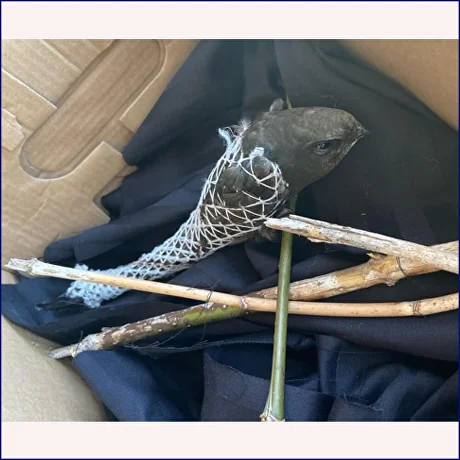
Incorrect fixation of a broken wing
Proper wing fixation
Suitable for fractures above the shoulder.
Fracture fixation scheme and description by avian veterinarian Tatyana Astafyeva.
“Take either thin cardboard or flexible plastic (I use the lid from a disposable container), cut out a splint in the shape of the healthy wing folded in its natural position. Place it on the injured wing on the side where there is no wound, and secure it crosswise with silk- or paper-based tape (so it can later be removed from the feathers). Or first lay down Flexum. Do not cover the wound; leave access to it and let air reach it.
Do not stretch the wing! Without complete alignment of the bones this is pointless, but it will cause pain to the bird. This should only be done under X-ray control and only when future flight is realistic, which is rare. It is better to fix the folded wing in its natural position and leave it for a couple of weeks.
Before applying the bandage, feel the wing. If it is cold below the fracture, there is no point. That means amputation, or if that is impossible, hoping for auto-amputation. In any case, the wing must be smelled, there should be no bad odor. In severe cases, antibiotics will have to be injected.”
For simple fractures, such as a radius fracture without displacement, and for bruises, this wing fixation option is suitable.
Try to put as little stress as possible on the broken wing. Bulky constructions are not suitable here, they only cause the swift pain. But paper tape and an ordinary paper clip work very well.
The best fixation option for a non-displaced radius fracture is self-adhesive bandage. It is elastic, so it tightly but painlessly secures the primary feathers and bones together into one unit. The primary feathers themselves serve as a splint for the radius.
You can buy it on Ozon, Wildberries, Magnit Market, or in veterinary pharmacies.
Be sure to give the swift pain relief!
With a wing fracture, Calcium gluconate should be given at 0.01 ml for every 10 g of body weight once a day. To help the bones heal faster, you can add Actovegin. Depending on the severity of the fracture, antibacterial drugs may also be prescribed. Consult a veterinarian in your city, an online recommended vet, or at least a consultation chat.
In this video, Tatyana Astafyeva shows how to fix a wing fracture properly using a splint and bandage. Hold the bird as shown in the video, head downward; in that position the bird will not even move.
Wing fracture fixation. watch this video on YouTube
Fixing the wing with a paper clip
In this method, an ordinary paper clip acts as the splint. It is placed on the wing and fixed with tape. It is better to use paper-based or polymer tape so the feathers are not torn out during removal.
1. Fold the wing into its natural position. Tear off a thin strip of adhesive tape and secure it tightly approximately in the middle of the first primaries.
2. With the second strip, after moving the feathers outward, secure the forearm closer to the body. Stick the tape toward yourself without leaving tails, because the tails will stick to everything and tear the structure off.
3. On the correctly folded wing (gently pull the joints slightly in opposite directions and bend/fold the wing; if successful it will look visually normal), stick a strip of tape and fold the ends inward. Stick it as close as possible to the fracture site, leaving the wound open.
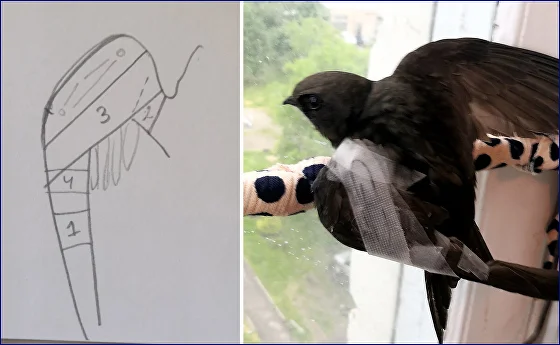
Fixing the wing with a paper clip
photo is clickable
With fractures, breathing must always be monitored. Sometimes even after pain relief the bird still breathes very heavily. Most likely this is a case where bone fragments are piercing internal organs. Unfortunately, such a bird cannot be saved.
X-ray
With serious injuries, or to be certain whether the bird will be able to fly, an X-ray is necessary. The most important thing is to position the swift correctly for the X-ray. With mild injuries (bruise, closed fracture), the X-ray is done after two weeks so as not to worsen the injury.
How to X-ray a swift
For the initial examination, only a direct ventrodorsal projection (on the back) is used. Do not touch, tape, or stretch the wings! Any manipulation of the wings can cause displacement and new fractures! A symmetrical image with the wings in their natural position is enough.
In this video, Tatyana Astafyeva shows how to position a swift correctly for X-ray so the image is clear and informative.
Lay the bird flat on its back. Pull the legs downward with your fingers, the head upward. Once positioned, the swift will spread its wings itself.
Why is it important to lay the swift flat on its back? With crooked positioning it is impossible to assess the integrity of the shoulder girdle.
Positioning a swift for the initial X-ray
The lateral (side) projection is done only when you are already sure that the humerus, forearm, and manus are intact, but questions remain about the condition of the clavicle, coracoid, or spine.
Doing this blindly, without a preliminary examination and palpation of the wings, and without evaluating the direct projection, can itself cause injury!
Positioning a swift for a lateral X-ray
This is what an initial swift X-ray looks like
On the left wing, a fracture is clearly visible that cannot be treated. With such a fracture, the bird unfortunately will not be able to fly.
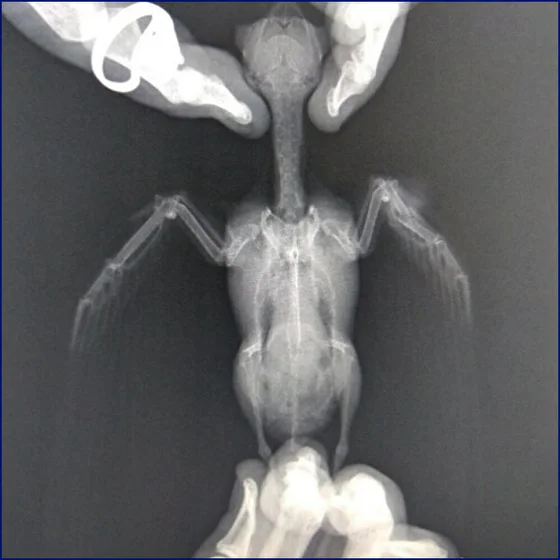
Initial X-ray
X-ray for a detailed view of the wings
If the injury is not recent (more than 2 weeks old) and the wings need to be imaged in detail, they are opened and stretched out. This must be done with 4 hands: wing and legs, wing and head.
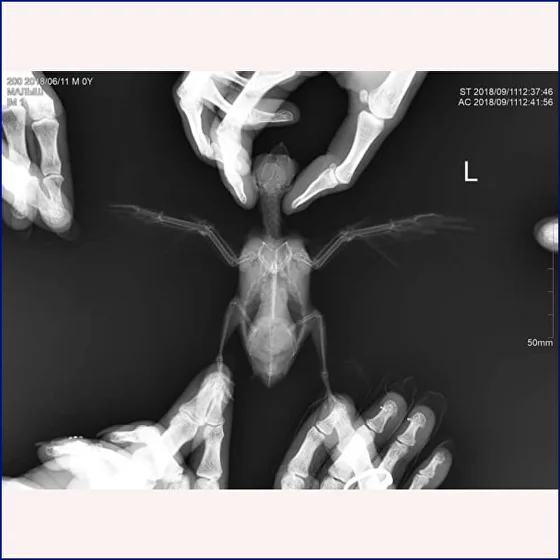
X-ray with stretched wings
X-rays must not be done on chicks with pin feathers and on weakened birds showing signs of a critical condition:
--- no reaction to people
--- labored breathing
--- extreme exhaustion
--- open fractures, bruises, and hematomas
In such conditions the bird must first be stabilized, and only then can an X-ray be done, carefully and with consultation.
Chicks are X-rayed only after all the feathers have emerged from their sheaths.
Image format
The clinic is required to send you the image by email or copy it to your storage device, for example a flash drive.
Ask them to send not only a jpg by email but also the DICOM file. That file can be opened only with special software, but it is the one doctors use because the image quality is very high.
They must give you the image even if you are not going to be treated at that clinic. Claims like “We do not release X-rays” are unlawful! You have the right to demand the image you paid for. This is a service and it must be provided fully and properly. Otherwise the clinic is violating Russian Consumer Protection Law No. 2300-1 of 07.02.1992 (as amended 14.07.2022).
Other problems
What else might you encounter while nursing a swift? These problems are covered below.
Blood loss in a swift
Swifts are very small birds and quickly lose vital strength when they lose blood. So it is important to stop wound bleeding quickly and begin resuscitation.
Apply a cotton swab moistened with Endoji or Capramin to the wound (Capramin can be ordered from Kazan-Express and is useful to have on hand).
You can also use a hemostatic sponge, sold in all regular pharmacies.
Etamsylate. Soak a cotton pad and apply it to the wound. Hold until the bleeding stops.
For 2-3 days, give the swift saline or Ringer-Locke solution. 10-12 drops of each per day, more if needed.
Bleeding in a swift
Etamsylate or Dicinone or Vikasol in ampoules. Do not dilute!
0.05 ml (1 drop) into the beak once a day. Give for 1-2 days.
Tranexam tablets 250 mg: dissolve ½ tablet in 2 ml water. Give 0.04 ml 2 times a day for 3 days.
Open wound in a swift
To prevent the wound from becoming inflamed and to help it heal faster, it must be treated.
Prepare a solution of Dioxidine + Novocaine 5 mg/ml. Mix 3 parts dioxidine and 1 part novocaine in a dark glass bottle. It can be stored outside the refrigerator. Several times a day, drip it onto the wound from a pipette or needleless syringe until the wound heals. The bitter novocaine may also help prevent the bird from pecking at the sore spot.
Eplan can also be used for wound treatment. It is sold in regular pharmacies. It is a relatively inexpensive product that heals wounds well.
For washing purulent wounds, Metrogyl (infusion solution 5 mg/ml) is suitable. It is sold in regular pharmacies and costs up to 50 rubles. Note that the solution is good for 5 days after opening the plastic ampoule; after that it must not be used and should be discarded.
Bruises and hematomas in a swift
A swift may be light, but it can still fall very badly and hit the ground hard enough to develop a hematoma.
If you discover a bruise under the feathers, it definitely needs treatment.
Traumeel gel or Traumeel S ointment resolves hematomas in 3 days. Heparin gel 1000 can also be used.
Traumeel S in ampoules: 0.1 ml (2 drops) into the beak 2 times a day. Traumeel tablets: dissolve 1 tablet in 2 ml water, give 0.1 ml (2 drops) 2 times a day.
Parasites in a swift
Swifts can have two types of parasites: louse flies and feather lice.
The first unpleasant creature is about the size of a normal fly, flattened, with long legs, similar to a deer ked. It moves very quickly, hiding in the feathers, and looks disgusting. It is not dangerous to humans or pets, unless you die of fright seeing it crawl out of the swift’s feathers. It is almost never seen in chicks. It occurs in adult swifts.
There is only one way to deal with it: catch it and execute it. Luckily, a swift usually has only one or two. They are very hard-bodied and difficult to crush, so the best execution method is flushing them down the toilet. Or catch one with a piece of tape, wrap it in the tape, and give it a private cremation.
Feather lice, on the other hand, are very small. You may notice them when they come near the eyes to drink. See those two little brown dots near the lower eyelid? That’s them: feather lice.
They are also harmless to humans and pets, but they bother the swift. With good hygiene they usually disappear quickly, because they do not tolerate cleanliness. But you can help them disappear faster: just place chamomile or wormwood from the pharmacy under the napkins at the bottom of the swift’s housing. Or both at once.
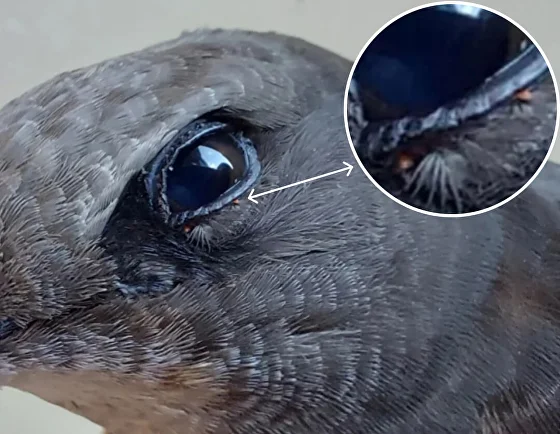
Feather lice near the eye
Eye injuries in a swift
Rinse several times a day with saline (from a syringe), then about 10 minutes later apply 1% tetracycline eye ointment.
More detailed treatment should be prescribed by a doctor.
Eye treatment in swifts may also involve medicines such as Solcoseryl gel, Korneregel, Maxitrol eye drops, Pilocarpine, etc.
When rinsing with saline, be careful not to flood the ear opening. Cover the ear with a cotton pad and hold it gently with your fingers without pressing. See where the swift’s ears are located.
How to clean a swift’s nostrils
A swift’s nostrils are very small and can become clogged with improper feeding. It becomes hard for the swift to breathe, just as it is for us with a blocked nose.
To see better, use a stationary magnifying glass or jeweler’s glasses. If you are very nearsighted, you will probably see everything perfectly well anyway.
For rinsing, furacilin solution is recommended. Dissolve 1 furacilin tablet in half a glass of boiled water. The solution can be strained or simply left until the sediment settles.
Watch the video carefully. It explains and shows everything clearly, prepared by swift carers who wished to remain anonymous.
How to clean a swift’s nostrils. watch this video on YouTube
Some people recommend using microbrushes to clean a swift’s nostrils. In the photo we can see that the microbrush is pink, which means it scratched the nostril.
No matter how soft a microbrush may be, it is still too stiff for a swift’s delicate beak and nostrils. Therefore the cotton-wrapped method shown in the video above is recommended.

The microbrush scratched the swift’s nostril
Infections
Staphylococci, enterobacteria, streptococci, oxytoca, Pseudomonas aeruginosa, and Candida can cause abscesses on various parts of a swift’s body and can also cause excessive salivation. If you find an abscess or saliva, a bacterial culture with antibiotic sensitivity should be done at a veterinary laboratory.
Abscesses in the mouth
In the mouth, abscesses most often appear on the palate, but sometimes also on the tongue.
Abscess near the beak
Abscess on the head
A common occurrence. If you feel a lump under your finger, part the feathers to see whether it is an abscess.
Multiple abscesses on the chest
Open the photo full size. Flat abscesses on the chest that could not be felt by touch. The swift began spitting out food; it seemed to eat, but reluctantly. When it vomited, the owner decided to give it an injection and, after parting the chest feathers, found a cluster of flat abscesses. Two days later the swift was gone.
Abscess above the eye
Open the photo full size, there are three different angles. This abscess above the eye was caused by Pseudomonas aeruginosa.
Abscess on the leg joint
It looked as if the joint itself was damaged
Six months later the abscess began to come out
Birds have thick pus that matures very slowly
The abscess itself and the toes turned yellow
This means the pus will come out on its own soon, and there is no need to cut, dig, or clean anything there
The pus that came out
The pus matured and fell out on its own
Candidiasis
White coating in the throat caused by candidiasis. The swift could not swallow crickets because of the coating. The second photo is after 2 weeks of treatment
Saliva in a swift’s mouth
Normally, a swift’s mouth is dry. Swifts have virtually no salivation. If you hear gurgling sounds while the bird is breathing, be sure to look into the swift’s mouth and check for saliva.
In this and the next video, provided by Olga, you can clearly see what a swift’s mouth looks like when saliva is present and how the bird behaves in that case.
Swifts have breathing slits on the tongue and palate. Saliva clogs these slits, the swift breathes badly and chokes. In effect it is drowning, because the saliva enters the trachea.
What saliva in a swift looks like
How a swift behaves when saliva is present
Look how distressed the bird is. Its mouth stays open all the time because it is hard to breathe. It shakes its head as if trying to fling something off. A rattling sound can be heard when it breathes. Normally a swift’s breathing is completely inaudible.
Remove saliva from the mouth with a cotton swab. It is best to use baby swabs. Wind the saliva onto the swab, cleaning the breathing slits as thoroughly as possible. Do this as saliva accumulates in the mouth.
After you have submitted a bacterial culture with antibiotic sensitivity, while you are waiting for the result, you can start giving Enroflon drinking solution 10%.
Dilute 0.1 ml of the medicine in 0.9 ml of boiled water (water for injection or saline), give 0.04 ml into the beak 2 times a day. Do not store the diluted solution. Also start antifungal therapy immediately with Irunin and Nystatin simultaneously (see dosages above in the section “Cat bites”).
What a swift looks like when saliva is present
Tumors and
Bumblefoot - pododermatitis
Rehabilitators from the German swift society call this gout. Pododermatitis is usually secondary and very often proves resistant to any treatment. It is the result of a systemic infection hidden inside, now showing itself externally in this way. After treatment, in most cases, the toes on the foot do not function properly and their mobility does not recover.
A swollen toe on a swift’s foot should be a warning sign
Swift feet have very thin toes. Any enlargement, even slight, means there is a problem that must be dealt with urgently.
Submit a bacterial culture with antibiotic sensitivity. With the right antibiotic, the foot deflates within a few days. But the full course must be completed so nothing remains undertreated.
While the culture is being prepared, you can give Sextaphage 0.1 ml 2-3 times a day for at least a month. When the analysis comes back and the appropriate antibiotic is added to Sextaphage, things go much faster. Sextaphage can also be dripped onto the foot. Store Sextaphage in the refrigerator. Shake the bottle, bend back the aluminum cap without removing it completely, wipe the rubber stopper with an alcohol wipe, and draw the liquid from the bottle with a sterile 5 ml syringe. Close the bottle, put it back in the box, and return it to the refrigerator. Then draw doses for oral administration from that syringe. Store the syringe in the refrigerator as well and shake before drawing. If the contents of the bottle or syringe turn cloudy, discard them.
Pain relief according to the protocol for mild cases is recommended, the swollen foot is hot and painful.
This is what the Germans write about the disease and what recommendations they give.
We have never managed to cure gout, because due to the tendon structure of the foot, it is impossible to completely eliminate the source of infection either by healing the abscesses or by cleaning them out. Conservative treatment methods, such as antibiotic bandages (for example chloramphenicol or tetracycline), also prove ineffective even when there is no obvious infection source.
If the gout is mild and the bird can be released soon, it should be released without hesitation (without ringing it!). In flight, a swift’s feet are hardly used; movement helps remove the fluid accumulated in the tissues. Therefore a swift with a mild form of gout has a better chance of recovery in the wild than in human hands.
How to submit a bacterial culture for a swift
Our golden little bird... especially when it gets sick and needs treatment. But it is not so much the treatment itself that is expensive as the procedure for determining which medicines are needed. Correct treatment usually requires a bacterial culture with antibiotic sensitivity. If any veterinarian reads this section, rather than feeling indignant, it is worth thinking about.
In a vet clinic, the test can usually only be done through an appointment. In that case the total quickly becomes quite high: appointment 2500 + each test 1680 for each infection + collection fee + whatever else they decide to add... In short, ordinary people often cannot afford this, and oligarchs do not pick up birds.
So we take another route. Go to any human medical laboratory (Citilab, Gemokhelp, Invitro) and ask them to give you a swab tube for a throat bacterial culture to take with you. To any questions, say it is for a bedridden relative. Take the swab in the morning before feeding the swift, i.e. on an empty stomach. Open the tube, rub the swab from the tube around the swift’s throat and mouth, put the swab back into the tube, and close it.
Take the tube to the laboratory. Give the name of any person the sample was supposedly taken from. Be sure to specify that you are submitting a throat bacterial culture with antibiotic sensitivity and that you want absolutely everything that grows to be listed. If finances allow, it is also useful to know antifungal sensitivity. The result usually comes in 3-4 days. After receiving it, send the analysis to someone who understands treatment.
How to take a swab from a swift’s mouth
If you have given even one dose of an antibiotic, there is no point in doing a bacterial culture. Because of the antibiotic, the clinical picture will be inaccurate. After finishing the antibiotic course, a follow-up culture should only be done after 2-3 weeks.
Cloacal prolapse
Cloacal prolapse occurs because of inflammation of infectious origin. The cloaca must be put back in place urgently. If this is not done, the exposed mucosa will dry out and infection will develop. This is almost certainly fatal.
Rinse the cloaca with warm chlorhexidine. Then put ice on a gauze pad and apply it to the cloaca. Hold for a couple of minutes. Then apply a cotton pad soaked with 40% glucose for about 10 minutes. This should reduce the swelling. If you do not have glucose at home, go to the pharmacy. If the pharmacy does not have it either, skip this step and move directly from the ice to reducing the prolapse.
Using your index finger or a cotton swab, well coated with Levomekol ointment, try to press the cloaca back into place with circular inward movements.
Do not panic. It will work. You need to act quickly, but without rushing. Do everything carefully and firmly, without sudden movements, constantly lubricating with Levomekol.
After reduction, temporarily feed soft food. Dip the first insect of each feeding in Duphalac to prevent constipation.
To prevent the infection from spreading, give Amoxiclav into the beak (see Cat bites).

Prolapsed cloaca
Cleaning construction foam from a bird’s feathers
During balcony and roof repair season, which traditionally coincides with nesting season, birds very often get covered in expanding construction foam. Whether chicks or adults, pigeons or swifts, if you find such a bird or caused this disaster yourself, you can help. Svetlana prepared a detailed guide on cleaning construction foam from feathers.
You will need: Dimexide concentrate for solution preparation, the softest possible toothbrush (not a hard one!) with the finest bristles, and paper towels.
All actions are described step by step under each photo. To see the photo full size, click on it.
Prepare the Dimexide, a soft toothbrush, a ceramic saucer, and thick paper towels.
Wrap the bird in a cotton napkin or paper towel, leaving exposed only the parts of the body where the hardened foam must be removed.
Pour Dimexide into a ceramic dish (saucer, bowl, ramekin), moisten the toothbrush, and start cleaning with stroking motions in the direction of feather growth.
Do not rush. All motions should go from head to tail. Do not rub, tear, or scrub side to side.
In 5 minutes, Dimexide dissolved and washed off the construction foam that had hardened two days earlier.
After complete cleaning, gently rinse the treated areas under running water to remove the Dimexide. Dry and smooth the feathers.
A white-rumped swift chick washed clean of construction foam. When it was pulled out from under the floor, the outermost tail feather was torn out. But it had time to regrow a new one. The chick successfully flew to Africa.
If feathers on the body are dirty, you will have to place a piece of oilcloth with a cotton backing under each feather so the Dimexide does not touch the skin, and carefully wipe each feather along the direction of growth with a flat goat-hair brush. Such a brush can be bought in stationery stores. Rinse off with cotton pads moistened with warm water. After water procedures, the bird must be dried thoroughly so it does not catch cold.
Any fat-dissolving product will inevitably remove the natural protective coating, and it will take time to restore it. After Dimexide, at least a month is needed before release.
How to feed a swift
Detailed video instructions for the process of feeding a swift
Getting ready for release
What to consider before releasing a swift


The site is constantly updated. Subscribe to the Telegram channel or VK group to be the first to hear about news and updates.
Help for swift rescuers
In these groups you can ask questions about problems that arise with your swift, and find a mentor who will help you nurse a chick. Do not hesitate to ask for help!















If the question is complicated and cannot wait, go straight to the chat, there people will respond quickly and help you. Be sure to read the pinned message in the chat, it contains important information that may already answer your question.



Click on the photo to go to the group or chat.
Blacklist
ATTENTION! There are groups, channels, and veterinary clinics you must not contact because they provide information that is harmful to birds. Read about them so you do not accidentally harm the bird.
If this site has been useful to you, you can leave a review for it on Yandex. This will help promote the site in search results so more people who have found a swift for the first time and do not know what to do can find it.
To do this, open the site on a computer in
Thank you for not abandoning a bird in trouble!

This is not for me. It is so Yandex sees that the site is useful and ranks it higher. And the higher the site is in search results, the faster people in need will find it, instead of landing on sites with harmful information. In this way you will help not only the swift you picked up, but also the swifts picked up by other people.
Click on the lock icon to the left of the site address. The Protect panel will open. Click the “Site reviews” line.

The site was created with the support of experienced swift rescuers and is an encyclopedic and educational project for promoting careful treatment of nature and preserving swift populations in particular. All materials presented on the site were taken from the recommended groups and chats listed above, and from ornithologists’ work on the study of swifts. The photographs were found in open sources (Yandex, Google). The many years of experience of hundreds of swift rescuers from different cities and countries has been structured and collected in this resource to make your search easier and provide you with the information you need and all the knowledge about swifts here and now.
I express my deep gratitude to all swift carers who contribute to Swiftpedia by sending useful photos, videos, and tips in private messages, and who share their knowledge and experience without wanting publicity. Without you, work on the site would move much more slowly.